




We Say It Because We Mean Well. But Jesus Never Said It.
There is a phrase most of us have said at least once. Probably more than once. Someone we love is going through something awful, and in the silence that follows, we reach for words that sound spiritual and true. We say: "Everything happens for a reason."
First of all, we mean well, and that’s important. But in part 1 of the new teaching series Stuff Jesus Didn’t Say, Pastor Steve Ingold made a compelling case that those five words, however well-intentioned, are doing more harm than we realize. And more importantly, they are not something Jesus ever said.
That's the premise of a new teaching series, "Stuff Jesus Didn't Say." Over several messages, we are honestly looking at phrases that have circulated in Christian culture for so long that they feel biblical, even when they aren't.
Where the phrase comes from
Most people who grab "everything happens for a reason" are probably thinking about Romans 8:28, where Paul writes that “God works in all things for the good of those who love him.” It's a beautiful promise. But it gets misread almost every time if it gets quoted in the middle of someone's pain.
Because, Paul does not say all things are good. He does not say God causes all things. And he certainly does not say every tragedy has a hidden divine reason behind it. What Paul actually says is that God works in all things. That is a very different truth. Because that means that the promise is not that suffering will make sense at some point. The promise is that suffering never gets the final word.
What Jesus actually does
To see what Jesus really does in the face of grief, look at Luke 7. Jesus is walking into the town of Nain when he crosses paths with a funeral procession. A widow has just lost her only son. In that culture, that loss for a woman meant losing just about everything. Her security, her standing in the community, even her future.
What does Jesus do? He does not offer her a reason for her loss. He does not explain God's plan or defend God's character. He just stops. He is moved at a gut level by what she is experiencing. And then he steps toward the pain.
What we can learn from Jesus here is that people do not need a neat explanation. People merely need our presence.
The permission to lament
As a church, we believe it’s important to reposition lament as a legitimate, even necessary, form of prayer. Western Christianity tends to prefer and lean more into “victory language.” We want resolution and triumph. We love a neat bow at the end of a story. But when we look at the Scriptures, we see, for instance, that the Psalms are full of honest, raw, sometimes angry prayers that ask God hard questions without clean answers.
"How long, O Lord?" "Where are you?" These are not prayers that lack faith that God’ll come through. No, they are honest prayers that are deeply biblical.
Jesus himself models prayer like this. In John 11, standing at the tomb of his friend Lazarus, knowing full well what he is about to do, Jesus still weeps. That tells us that grief is not a lack of faith; it is an expression of love.
Three things to take away
Here are three points that are worth remembering:
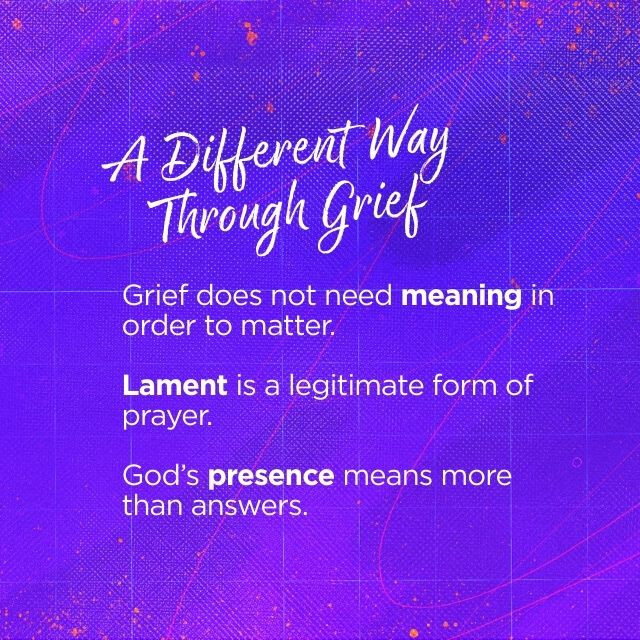
Grief does not need meaning to matter. You do not have to turn your pain into some sort of lesson for it to be real or valid before God. You are allowed to just mourn without having to explain it.
Lament is a legitimate form of prayer. Bringing your confusion, anger, and sorrow to God in an honest way is not doubt; it is faith speaking the truth.
God's presence means more than answers. The hope of the gospel is not that we will always understand suffering; it is that we will never have to face it alone.
Why are these truths so applicable today?
We live in a world right now where a ton happens, all. the. time. And all that loss, uncertainty, grief doesn't resolve on a tidy timeline. The people around us, in our neighborhoods and at work, our families all need something more honest and real than just a phrase that aims to explain their pain away.
What they need, and what we need, is exactly what Jesus offered the widow outside Nain. Not a bunch of theology, but our presence. Not several “reasons,” but someone who is willing to stop, be moved by it, and then step toward the pain rather than skip past it.
That is the kind of community Cornerstone is trying to become.
You can watch Steve Ingold's full message on our YouTube channel. If it connects with someone you know, share it with them. Sometimes, the most helpful thing we can do is hand someone a better framework for the hard things they are already walking around with.
This article is based on "Stuff Jesus Didn't Say" taught by Pastor Steve Ingold at Cornerstone Fellowship on March 15, 2026.

Login To Leave Comment